What happens to an attraction when the sun goes down? For most, the answer has traditionally been simple, the gates close, the visitors leave and the site falls quiet until the next morning.
But I think there is a much more interesting opportunity. Attractions have spent years investing in incredible landscapes, buildings, environments and visitor experiences. Why should all of that stop working when daylight disappears?
At LCI Productions, we’ve seen the potential of what happens after dark first-hand through our work with Port Lympne, where we designed and installed the park’s first-ever after-dark experience last year. Following its success, we’ve now secured the contract to deliver Port Lympne Illuminated for the next three years.
For me, it’s a great example of how an attraction can give itself a second lease of life.
Bringing a sleeping park to life
Port Lympne is a very different place at night. During the day, it’s a busy wildlife park filled with visitors exploring its extensive grounds and seeing the animals. Once the animals settle down and the daytime activity comes to an end, the atmosphere changes completely.
There’s a sense of calm and serenity across the park. That became a really important part of our thinking when we developed the Illuminated experience.
Rather than trying to recreate the daytime experience after dark, we wanted to embrace the fact that this was a different Port Lympne.
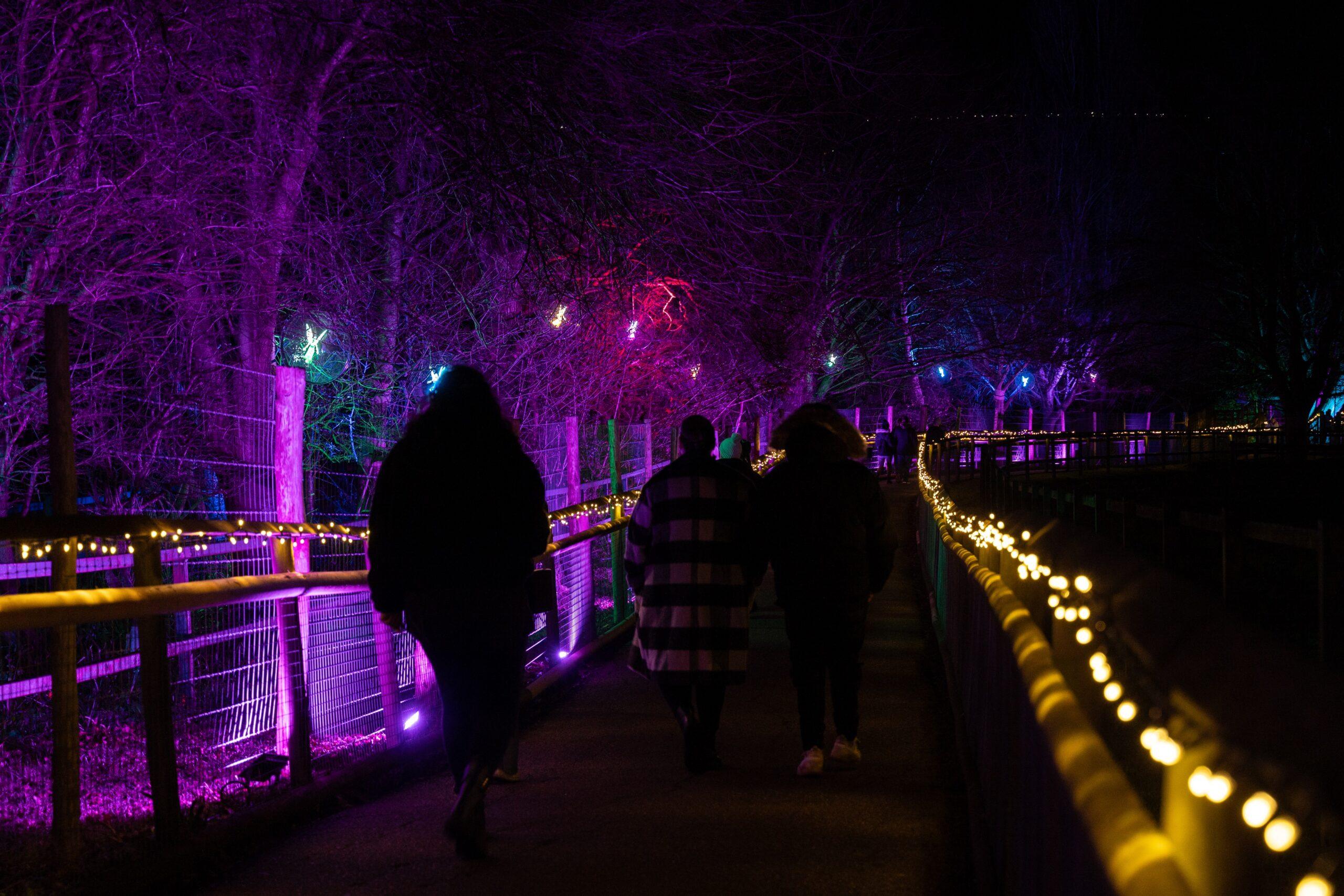
The light trail weaves its way through the main pathways of the park, allowing guests to experience a familiar environment in a way they have never seen before.
The landscape becomes the experience. Paths that visitors walk along during the day are transformed through light, colour and atmosphere. Familiar surroundings take on a completely different character, while the quietness of the park creates a feeling that is almost impossible to replicate during opening hours.
While the animals sleep, the park comes alive in a completely different way.
Giving an attraction a second lease of life
This, for me, is the real opportunity with after-dark experiences. It’s not simply about extending opening hours. It’s about extending the life of the attraction itself.
Without Illuminated, there would ordinarily be a point when the animals are bedded down, the park is closed and silence falls across the site.
Instead, the landscape is lit up. Visitors arrive for a completely different experience, moving through the park at a slower pace and seeing an environment they may already know transformed into something new.
It creates a second chapter to the day. And that can be incredibly powerful for attractions.
You don’t always need to build something new
One of the things I particularly like about the Port Lympne project is that we’re not asking the park to become something it isn’t.
The landscape is already there. The pathways are already there. The buildings, views and natural environment are already there. We’re simply changing how visitors experience them.
That can be achieved through lighting, projection, sound and carefully considered content, without necessarily requiring major permanent construction.
It opens up a lot of possibilities for attractions that are looking for ways to create new experiences while making better use of the assets they already have.
A garden can become an illuminated journey. A historic building can become a canvas. A lake can become a focal point. A familiar pathway can suddenly feel completely unfamiliar.
Technology helps us do that, but the environment is still the star.
Creating a reason to visit after dark
There is obviously a commercial opportunity here too. For attractions, particularly those with seasonal peaks and quieter periods, an after-dark experience can create another reason to visit.
It can extend the operating day, bring people to the site during periods when they might not otherwise visit and create additional opportunities for food and beverage, retail and other visitor spending.
But the important thing is that the experience has to be worth coming for. People aren’t necessarily going to buy a ticket simply because an attraction is open for an extra few hours.
They will come because there is something they want to see. That’s why the experience itself has to be the starting point.
At Port Lympne, the appeal isn’t that visitors can walk around the park after dark. It’s that they can experience somewhere familiar in a completely unfamiliar way.
The technology should support the environment
At LCI, we’re obviously interested in the technology that makes these experiences possible.But I don’t think technology should ever be the main attraction.
The best use of lighting, projection, audio and immersive technology is when it feels completely natural to the environment.
With Port Lympne Illuminated, the technology has to work with the park rather than overpower it. The light trail needs to complement the landscape. It needs to create an atmosphere without taking away the feeling of being somewhere special. That balance is important.
You want visitors to notice the experience, but you also want them to stop and appreciate where they are.
The technical reality behind the experience
Creating an outdoor after-dark experience also comes with a very different set of technical considerations.
You’re working in a live environment, often across a large site, with weather, power, infrastructure, safety, access and visitor movement all needing to be considered.
At Port Lympne, the scale of the park and the natural environment make that particularly interesting.
Every element has to be carefully planned and installed so that the finished trail feels effortless for the visitor. That work happens long before the first guest arrives.
For us, the challenge is always to make the technical complexity disappear into the experience.
The audience shouldn’t be thinking about how the lights have been installed or where the equipment is positioned, they should simply feel like they’ve stepped into a different world.
From one year to the next
The fact that we’ve now secured the contract to deliver Port Lympne Illuminated for the next three years is particularly exciting for us. It gives us the opportunity to build on what we created in the first year, learn from how visitors interact with the experience and continue to develop it. That’s another reason I think after-dark experiences have such potential. They don’t have to be static, they can evolve.
New content, new lighting, new moments and new experiences can give returning visitors something different to discover, while the event itself becomes something people look forward to each year. Over time, what starts as a seasonal event can become part of an attraction’s identity.
A new life after dark
Port Lympne Illuminated demonstrates what attractions can achieve when they stop thinking about the end of the day as the end of the experience. The park doesn’t just close when the animals go to sleep, it changes.
The daytime energy gives way to something quieter, more atmospheric and immersive. The pathways become a light trail. The landscape becomes a canvas. And a place that would ordinarily be silent becomes full of life again. That’s the real opportunity with after-dark experiences, not just keeping an attraction open for longer, but giving it a second lease of life.