Dwell time is one of the clearest indicators of a successful experience. The longer people stay, the more engaged they are and the more likely they are to connect, remember and return.
It also has a direct commercial impact. Increased dwell time drives higher food and beverage sales, boosts secondary spend and improves overall return on investment.
But dwell time isn’t something you can force. It has to be designed.
So how do you create an experience people don’t want to leave?
Start with emotional connection
People don’t stay because something looks impressive. They stay because it makes them feel something.
Whether that’s wonder, curiosity, nostalgia or excitement, emotional connection is what holds attention over time. Without it, even the most technically advanced installation becomes something people simply walk past.
So the question becomes: how do you design for feeling, not just visuals?
Make the audience part of the story
The most effective experiences are not observed, they are entered.
When visitors feel like participants rather than spectators, their behaviour changes. They slow down, explore more and invest more time in the environment around them.
This is where storytelling becomes critical. A clear narrative gives people a reason to move forward, discover what’s next and stay engaged throughout the journey.
Design for interaction
Interaction doesn’t always mean complex technology.
Simple, well-considered moments of engagement can be just as powerful. The key is giving visitors something to do, not just something to look at. When people interact, they explore more, repeat behaviours and share the experience with others, all of which naturally increases dwell time.
Think multisensory, not just visual
Our world is inherently multisensory, so experiences should be too.
Light, sound, spatial design and subtle environmental cues work together to create an atmosphere. When these elements are aligned, the experience feels immersive rather than staged.
Sound plays a particularly important role. Carefully designed audioscapes can influence how people move through a space, where they pause and how long they stay.
Create space to pause
Not every moment needs to be high energy.
Moments of calm, reflection or simply space to sit and take things in are just as important. Integrating food and beverage, rest points or social spaces allows visitors to extend their stay naturally, without feeling managed or directed.
Design for different audiences
No two visitors experience something in the same way.
Families, couples, younger children and adult audiences all engage differently. Designing with this in mind creates multiple layers within the experience, allowing people to engage at their own level and pace.
When an experience works across a wide audience, dwell time increases organically.
Build a journey, not a moment
Experiences that hold attention are structured as journeys.
They have a clear beginning, moments of build and release, and a sense of progression. Visitors should feel guided, but not restricted, able to move at their own pace while still following a narrative arc.
This balance between structure and freedom is what keeps people exploring and staying longer.
Case study: Windsor Illuminated
A strong example of this approach is through our work on Windsor Illuminated.
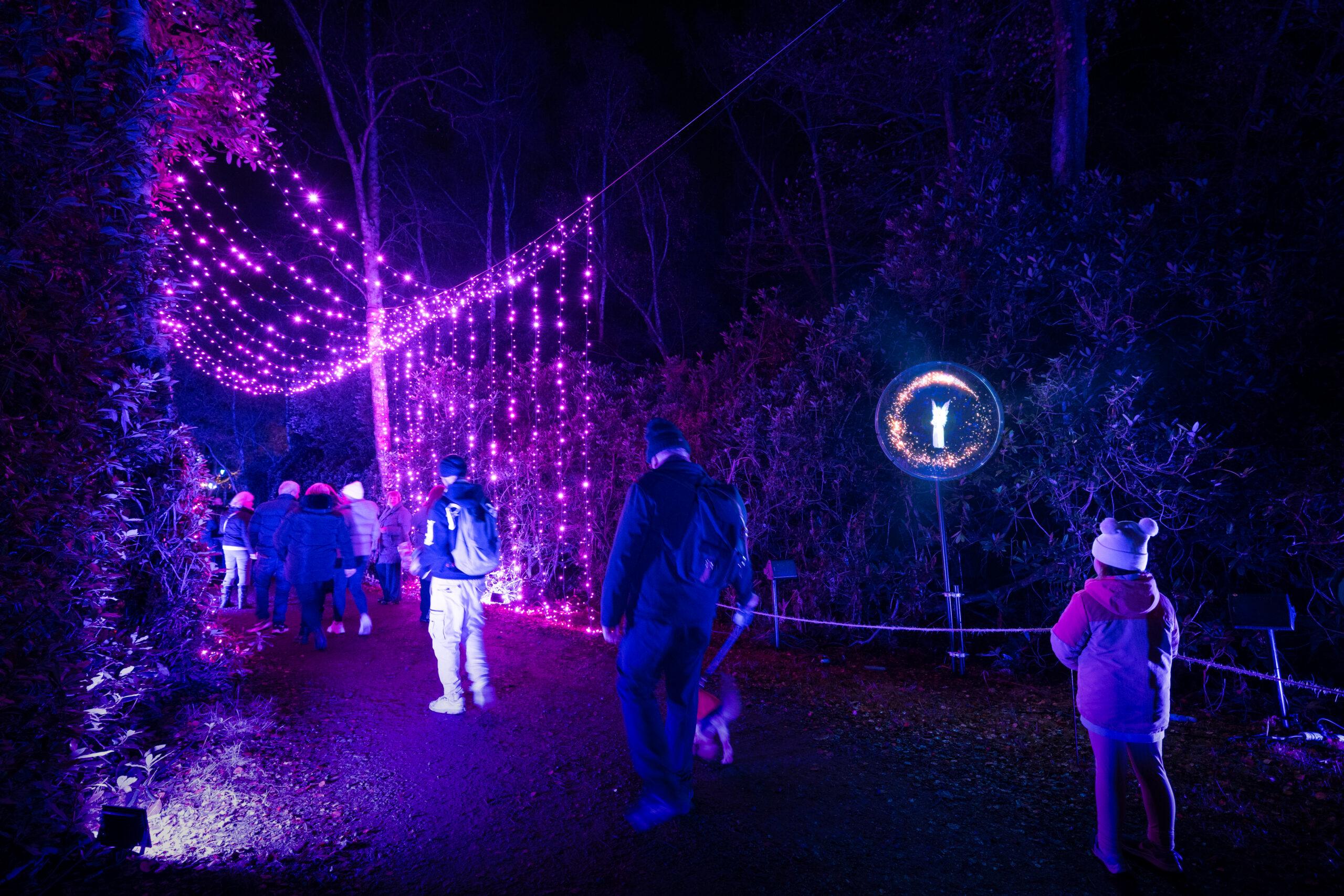
The experience was designed as a series of connected environments, each with its own mood, pace and sensory identity. Visitors moved through illuminated pathways, interactive installations and atmospheric zones, guided by light and sound.
Rather than relying on a single “wow” moment, the experience layered storytelling, multisensory design and spatial flow to create a continuous journey. Guests were free to explore at their own pace, with moments to pause, interact and reflect along the way. By using this design method we give the audience agency or perceived agency.
The result was increased dwell time, stronger engagement and a memorable shared experience for a wide range of audiences.
It’s not about holding attention. It’s about earning it.
Designing for dwell time is not about adding more. It’s about aligning every element of the experience to create something people genuinely want to spend time in.
When emotional connection, storytelling, multisensory design and pacing come together, you don’t need to encourage people to stay, they choose to.
If you’re looking to design an experience that connects more deeply with audiences and keeps them engaged for longer, get in touch with the LCI team.