When we talk about immersive experiences, most people still think about visuals first. Big projections, LED screens, the content that surrounds you, and for a long time that’s been enough.
But increasingly, it feels like we’re reaching a bit of a ceiling with purely visual immersion. Not because it doesn’t work, but because audiences are starting to expect more.
What we’re seeing now is a shift towards something deeper, and that’s Multi-sensory experiences…
It’s no longer about what you can see
Think about the experiences you actually remember. It’s rarely just what something looked like. It’s the atmosphere, the sound, sometimes even the unexpected details you didn’t consciously notice at the time.
That’s because when you engage more than one sense, the experience starts to feel more real and more personal, more built especially for you.
There’s a growing body of thinking around this that the more senses you involve, the stronger the emotional connection and memory becomes.
And that’s exactly what immersive experiences are trying to achieve.
We’re moving from AV to something broader
Traditionally, AV has done a lot of the heavy lifting in immersive spaces, visuals and audio working together to create impact, but now, we’re starting to design beyond that.
We’re seeing:
- Touch becomes part of the interaction
- Scent is being used to create an atmosphere or trigger memory
- Taste is even being introduced as part of storytelling
And these haven’t been added in as gimmicks, but as considered parts of the experience.
Experiences now seem to be less about layering technology, and more about thinking holistically about how a space actually feels.
A good example of this shift
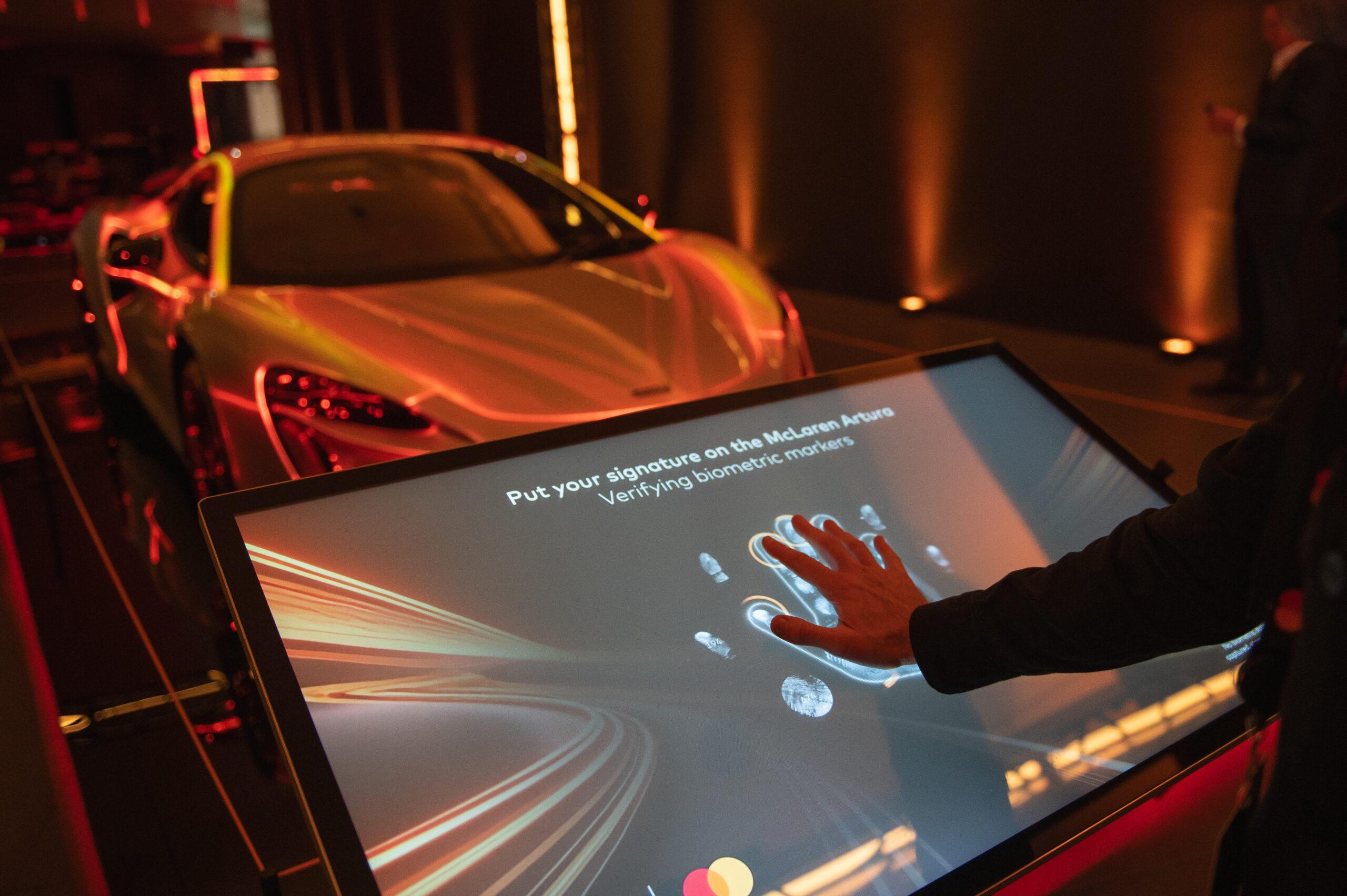
A recent example of this in practice was the Mastercard Innovate2025 experience we delivered with big group.
The challenge was an interesting one, how do you communicate complex, often abstract ideas like digital identity, security, or AI-driven commerce in a way that people genuinely understand? We decided this couldn’t be achieved with more screens or presentations but what if we created something visitors could actually feel?
So the experience was built around the five senses. Each moment connected to a different part of the story, whether that was sound, taste, touch, scent, or visual interaction.
Guests could physically engage with the content, not just observe it. And that shift made a noticeable difference in how people connected with the brand.
For touch we used biometric technology to scan visitors’ physical handprints and project them onto the bonnets of Mclaren cars. For scent, visitors discovered their scent profile and received a personalised perfume and for taste, the brand was paired with a special Dubai style chocolate to delight visitors at the end of the experience.
These all worked together to create an experience that both drew the visitor in, and allowed them to experience the brand on multiple levels.That shift had a noticeable impact on how people connected with the brand.
The role of lighting, set, and animatronics
While multi-sensory design expands the creative toolkit, lighting remains foundational.
It shapes atmosphere, controls emotional pacing, and guides attention often without the audience even realising it.
Unlike architectural lighting, which prioritises visibility and function, themed lighting is rooted in storytelling. It reveals and conceals. It directs focus, builds tension, and creates mood. It tells you where to look, what to feel, and sometimes even what to fear.
We can use light as a narrative device, some examples of these are:
- Colour temperature to influence emotional tone, from warm and inviting to cold and unsettling
- Contrast and shadow to heighten sensitivity and anticipation, allowing darkness to become as powerful as light
- Movement and transitions to create rhythm and progression, subtly shifting a space over time
But lighting doesn’t work in isolation. Its true impact is realised when it’s integrated with set design and animatronics.
Set builds provide the physical world, think of it like the textures, materials, and spatial depth that ground an experience in something tangible. Whether it’s a weathered façade, a futuristic interior, or a natural landscape, the set gives lighting something to interact with. Surfaces catch light differently, shadows fall with intention, and the environment begins to feel believable.
Animatronics then bring that world to life.
Through movement whether subtle or overt, they introduce a sense of presence. A figure that breathes, a creature that shifts in the shadows, or an object that reacts to a guest’s proximity adds a layer of unpredictability and realism that static environments can’t achieve.
When combined, these elements create something far more powerful than the sum of their parts:
- Lighting highlights key moments within the set, guiding the audience’s gaze
- Set design enhances the quality and texture of light, making spaces feel rich and dimensional
- Animatronics add timing and motion, reinforcing narrative beats and emotional responses
Together, they operate like a form of environmental theatre.
Imagine walking through a dense forest set: dappled lighting filters through overhead branches, the air feels still, and just as your eyes adjust to the low light, something moves in the periphery. A branch shifts. A figure turns. The space reacts.
That’s where immersion happens, not just through a single element, but through the careful orchestration of many working together.
Thoughtful lighting used alongside set builds and animatronics, can transform spaces into a story, something you don’t just see, but physically and emotionally experience.
Why this matters for attractions
This isn’t just something that can be brought to brand events either. It has real relevance for attractions, museums, and visitor experiences. Because ultimately, the goal is the same: create something people will remember.
Multi-sensory design can also help to keep people in a space for longer, make stories easier to understand, create more emotional engagement and perhaps most importantly, give people a reason to come back.
Right now, most immersive experiences still lean heavily on sight and sound. Which means there’s a real opportunity for this to expand much further. The next wave of immersive design won’t necessarily be bigger or louder, but it’ll be more considered. more layered and more connected to how people actually experience the world.
If you want to read more about our recent work with Mastercard, check out the full case study here: https://www.lciproductions.com/our-work/innovate2025-mastercard-experience/